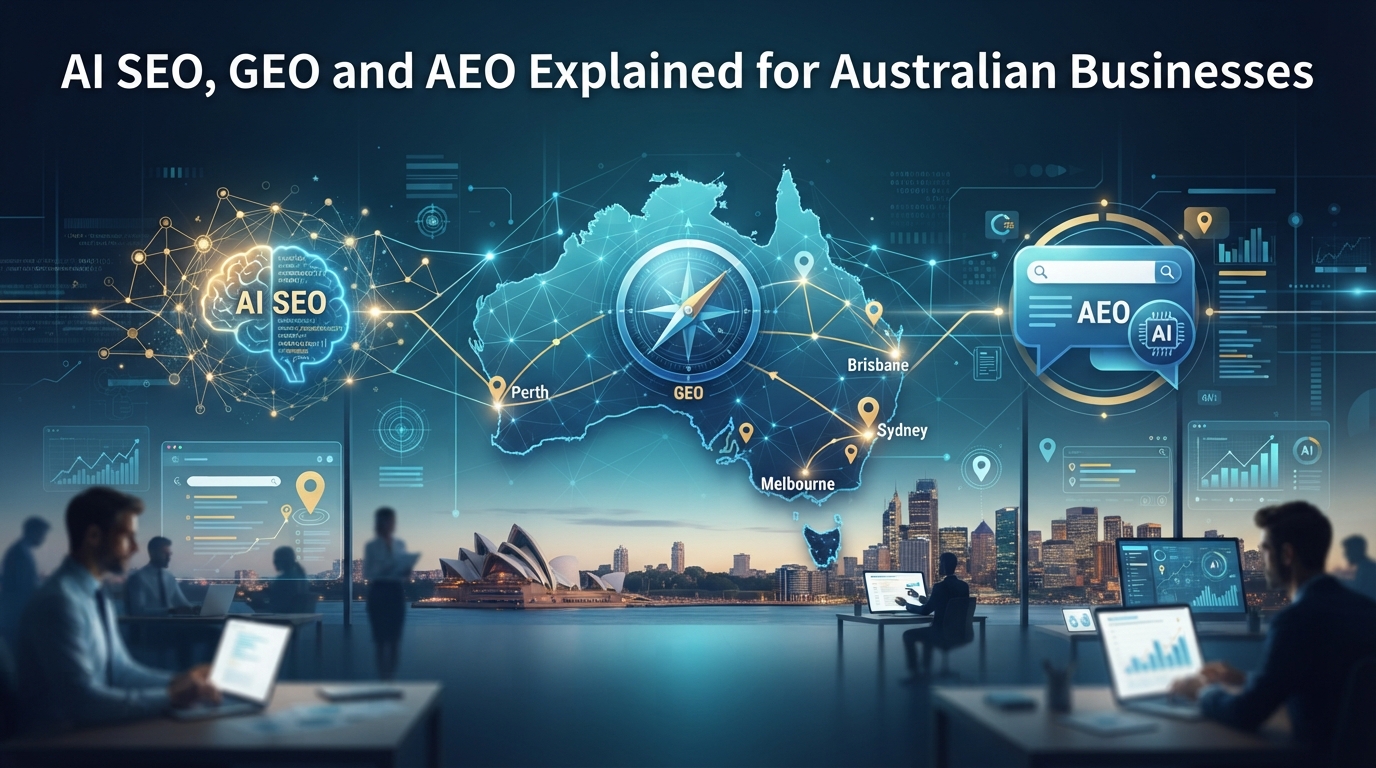
There isn’t one official new name for AI SEO. Instead, a handful of related terms have emerged to describe different parts of a discipline that has expanded rather than been renamed: GEO (Generative Engine Optimisation) describes optimising for AI tools like ChatGPT and Google AI Overviews, AEO (Answer Engine Optimisation) describes structuring content to directly answer specific questions, and both sit alongside traditional SEO rather than replacing it. If you’re hearing these acronyms and wondering whether you need to buy something new, the short answer is: the goal is the same as it’s always been (being found and trusted), but the channels you need to be found on have multiplied.
Table of Contents
- Why so many acronyms for what sounds like the same job?
- Is GEO just a buzzword, or a distinct discipline?
- Do you need a separate specialist for AI search versus Google search?
- Will your existing SEO work still help you in AI search?
- The bottom line
Why so many acronyms for what sounds like the same job?
Search behaviour has genuinely changed. People still type questions into Google, but increasingly they also ask Siri, ChatGPT, or Perplexity to recommend a business, compare options, or answer a question outright, often without ever clicking through to a website. That’s a meaningfully different mechanism to the “ten blue links” model SEO was originally built around, so it’s reasonable that new vocabulary emerged to describe it.
The confusion is that marketers have coined slightly different terms to emphasise slightly different angles of the same underlying shift:
- SEO (Search Engine Optimisation) is the umbrella term for making a business easy to find and rank in search results.
- GEO (Generative Engine Optimisation) specifically refers to optimising for AI engines that generate a synthesised answer rather than a list of links, such as ChatGPT, Perplexity, Gemini, and Google AI Overviews.
- AEO (Answer Engine Optimisation) overlaps heavily with GEO but tends to focus on the content side: structuring pages so they directly and clearly answer the exact questions people ask, which makes that content easier for both AI systems and traditional search to lift and cite.
In practice, most agencies use GEO and AEO almost interchangeably, and neither is a replacement for SEO. They’re better understood as an expansion of the same discipline into new territory, using some familiar tools and some new ones.
Is GEO just a buzzword, or a distinct discipline?
It’s a fair question, because a lot of “new” digital marketing terminology is just repackaged advice. GEO does overlap substantially with good SEO practice: both care about having accurate business information, structured data, and content that clearly answers what a customer is looking for. If you’ve been doing SEO properly, you’re not starting from zero.
But there are real differences worth understanding, because they change what gets prioritised:
What’s being optimised for. Traditional SEO optimises for ranking algorithms that return a list of links. GEO optimises for language models that read your content, decide whether to trust it, and then summarise or cite it directly in a conversational answer. That’s a different kind of “winning”: you’re not aiming for position one on a results page, you’re aiming to be the source an AI decides is credible enough to name.
What signals matter. Google’s ranking algorithm weighs things like backlinks, page speed, and keyword relevance. AI engines lean more heavily on verifiable trust signals: whether your Name, Address and Phone number (NAP) are consistent everywhere you’re listed, whether your website has valid structured data (JSON-LD schema) telling machines exactly what kind of business you are, and whether independent sources like your Google Business Profile or LinkedIn page corroborate that you exist and do what you say. A business can rank reasonably in Google yet be invisible to an AI engine if these signals are missing or inconsistent.
How content needs to be written. AEO in particular rewards content that answers a question plainly and early, rather than content optimised to hold a reader’s attention through a long article for the sake of dwell time. AI engines tend to lift concise, direct answers, so burying the answer under three paragraphs of preamble works against you.
So GEO isn’t a fake discipline invented to sell a new service, but it’s also not entirely separate from SEO. It’s more accurate to think of it as SEO’s scope widening to include a new category of “search engine”, the generative kind, which has its own quirks.
Do you need a separate specialist for AI search versus Google search?
Not necessarily a separate person, but you do need someone (in-house or an agency) who understands both, because the two disciplines share a lot of groundwork. Schema markup, consistent business listings, and answer-first content all help your visibility in Google’s traditional results and in AI-generated answers. There’s little value in treating them as two unrelated projects run by two unrelated teams.
Where it gets more specialised is in the auditing and diagnosis. Understanding why an AI engine isn’t citing a business requires checking specific things: is structured data present and valid, is NAP data consistent across the web, does the business have enough independently verifiable “entity” signals to be trusted, and is content actually structured to answer questions directly. This is a more granular, technical checklist than a general SEO health check, which is why some agencies (including ours) now offer GEO-specific audits as a distinct product, even though the fixes often improve both traditional and AI search performance simultaneously.
Will your existing SEO work still help you in AI search?
Largely, yes. If you’ve invested in a fast, well-structured website, consistent local listings, and clear content, that groundwork carries over and continues to matter. What traditional SEO alone won’t cover is the newer layer: whether your structured data is complete enough for an AI to confidently identify what your business is and where it operates, and whether your content is written in a way that’s easy for a language model to extract and cite verbatim. Those are worth checking specifically rather than assuming your existing SEO has you covered.
The bottom line
AI SEO hasn’t been renamed so much as it’s grown a couple of new limbs: GEO for optimising toward generative AI engines, and AEO for the answer-first content practices that support it. Neither replaces SEO; they sit alongside it and often share the same technical foundations. If you’re unsure where your business currently stands, a GEO audit is a practical starting point, ours checks six specific signals including schema health, NAP consistency, and AI citation readiness, and gives you a plain-English list of what to fix first.
See Your GEO Score in 60 Seconds
Find out exactly where your business stands on AI search — free, no credit card needed.
Get My Free GEO Audit